
Tambo Project
ECR’s Tambo project is located approximately 375km east of the capital city of Melbourne. The project resides within the historical goldfields of Swifts Creek where recorded production is in excess of 3,000 kg of gold.
The Tambo project consists of one recently granted exploration licence (EL007284) and one exploration application (EL007486). The area contains the Ensay Shear Zone which divides the project into two metallic provinces. The west side of the shear features gold rich mineralisation deposits, whereas the east side of the shear features deposits richer in base metals. The project lies within a friendly region where gold exploration is typically encouraged by local landowners.
Exploration by ECR to date has shown initial encouraging results from underground sampling at the historic Duke of Cornwall Mine including channel samples across quartz veins up to 0.2m @ 22.2 g/t Au and 0.5m @ 5.72 g/t Au coupled with highly anomalous gold in soils. The gold mineralisation also contains elevated levels of bismuth (up to 422 ppm Bi).
In late 2024, we embarked on and completed a diamond drilling campaign at Tambo consisting of five diamond drill holes and a total depth of 428 metres.
The drilling campaign’s objective was to investigate the structural controls on gold mineralisation and associated geochemical haloes, particularly beneath and adjacent to the historical Duke of Cornwall mine workings. Best results from the overall programme include 0.4 metres @ 8.51 g/t Au from Drill Hole DOCD002 and 0.15 metres at 10.6 g/t Au from Drill Hole DOC004.
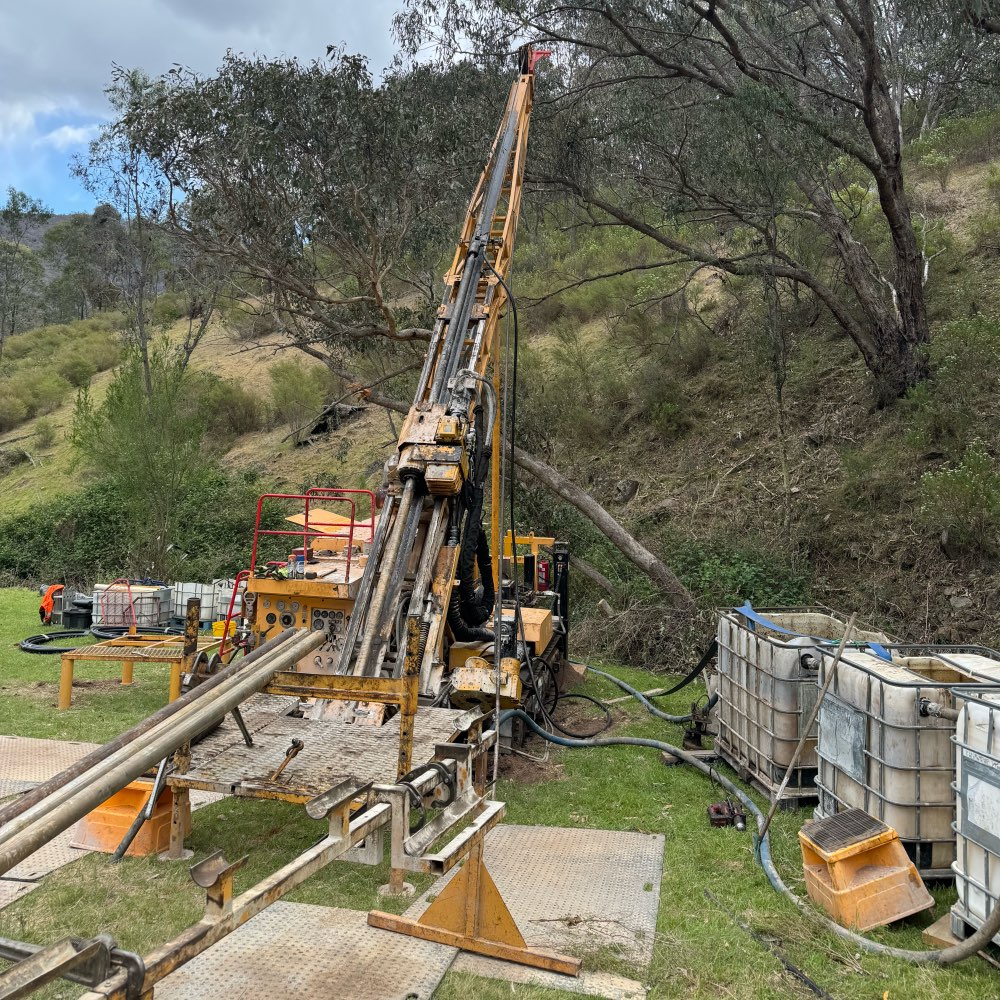
The campaign provided valuable structural data, confirming the association of gold mineralisation with quartz veining adjacent to the main shear zone. A secondary control, possibly plunging concentrations of mineralisation along strike, is starting to be evidenced by the drilling and will be studied in more detail. The Duke of Cornwall Lode system remains largely untested, with approximately 80% of its strike length unexplored.
Importantly, the drilling campaign successfully demonstrated that mineralisation continues at depth below the old mine workings in key areas and considerably enhanced our geological understanding of the prospect. This year we intend to design a follow-up drilling campaign focusing on deeper exploration beneath the high-grade zones identified in DOCD002 and DOCD004 as well as incorporating the structural and geochemical insights gained to explore central portions of the Lode, which remain prospective for gold mineralisation.