Lolworth Project
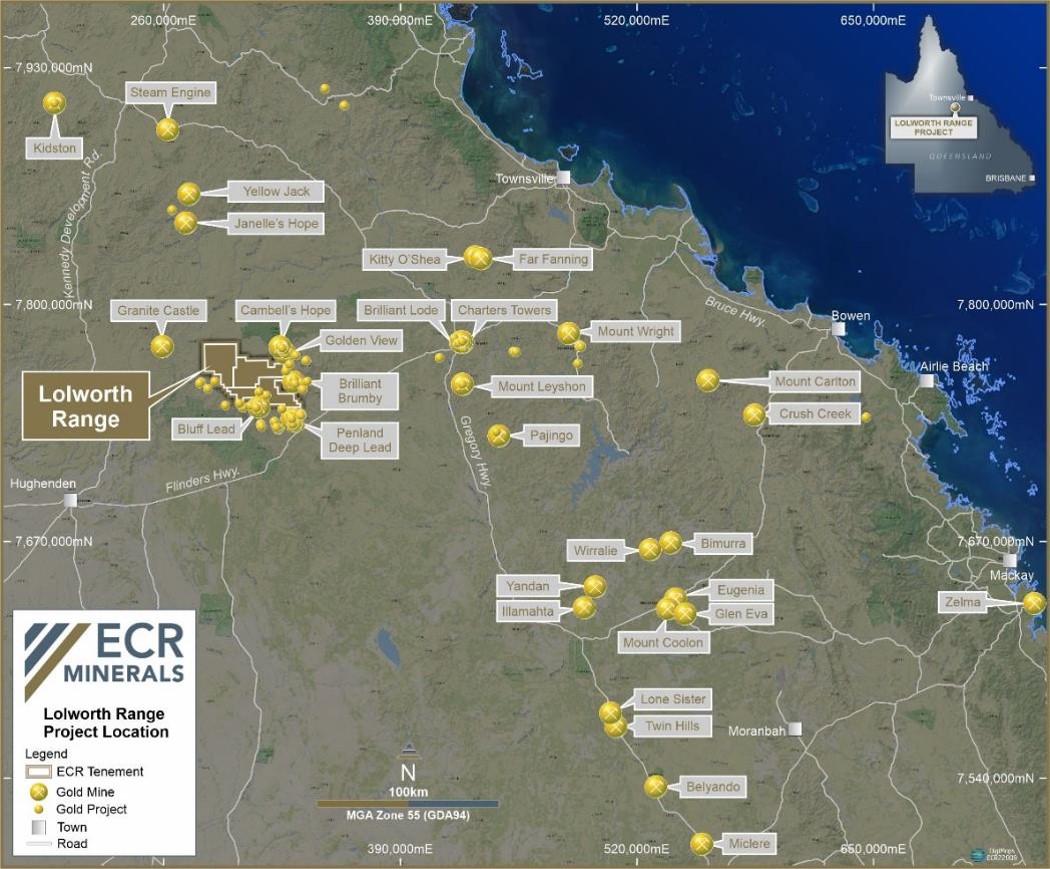
The Lolworth Project, spanning approximately 900 km2 in total, is located 150 km west of the historically rich centre of Charters Towers in North Queensland. The Lolworth Project is a large-scale exploration project prospective for gold, silver, lead and rare earth elements. The Lolworth Project remains free of native title claims, enabling straightforward and low-cost exploration access.
Our Lolworth Project is made up of 3 areas. Given its enviable location, it is perhaps surprising that the area has seen little modern exploration despite the presence of gold in the nearby area.
The rocks of the Lolworth area were always considered by ECR to be similar to the host rocks in the nearby and well-known gold rich provinces of Charters Towers and Ravenswood, that is a complex of schists and granite rocks that have undergone some degree of metamorphism. Parts of the project area also contain intruded pegmatites.
The project is an aggregate of three exploration permits (EPM27901, EPM27902 and EPM27903) granted in 2022 and covering the western end of the Lolworth Range.
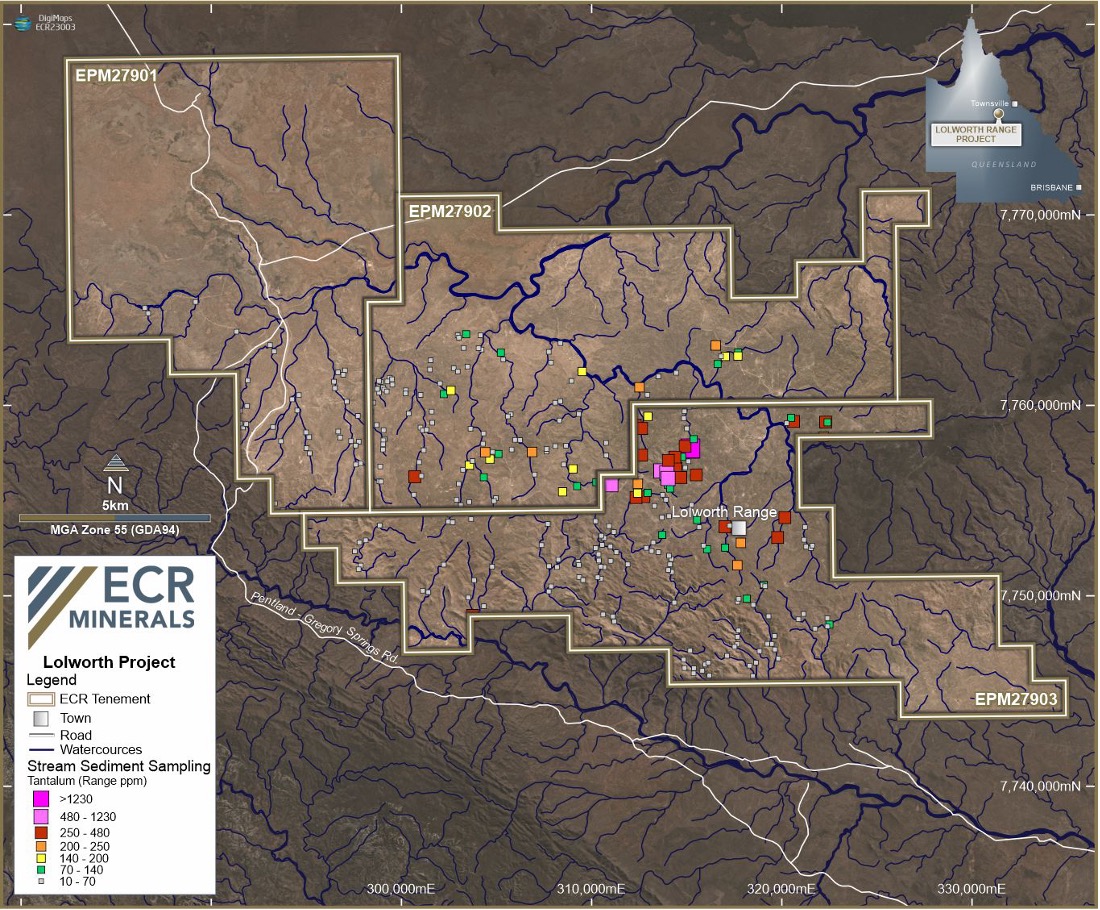
Exploration since then identified multiple gold bearing streams within the area. The work has led back to potential sources of mineralisation at prospective locations known as Reedy-Butterfly Creek, Upper Gorge Creek and Flaggy Creek. Stream sampling has also shown the presence of Niobium- Tantalum, Neodymium and REE mineralisation with the best indicators at Oak Creek.
After a successful campaign of surface exploration, we completed our maiden drill programme in 2025 which successfully validated our geological interpretation of gold and silver-bearing vein systems at Uncle Terry prospect, with all predicted veins intersected. ECR drilled 21 reverse circulation (“RC”) holes at the Uncle Terry prospect and a further seven at the Gorge Creek West prospect, to depths of between 30 and 42 metres.
Summary of the Maiden Drilling Campaign at the Lolworth Project
A total of 28 reverse circulation drill holes (1,058 metres in aggregate) were completed in September and October 2025 over two gold prospects at the Lolworth Project known as Uncle Terry and Gorge Creek West. This is the first drilling campaign to be completed by an exploration company within this part of the Lolworth Range. Drilling followed up on previous years’ rock chip sampling of outcrops, where sporadic Galena (AgPb sulphide) mineralisation had been observed.
The Uncle Terry prospect was formally named and discovered by previous project holders A.R.I Limited in 1988 where Galena was observed in a quartz outcrop. Grab samples from the outcrop during their discovery included 34 g/t Au and 6 g/t Au.
The original location of the discovery has only been recently identified. The outcrop was initially thought to strike in a north-south direction; however, ECR’s recent mapping and drill programme suggests that the vein strikes east-west, dipping to the south.
See Figure One for the location of drill holes at Uncle Terry and Figure Two for the location of drill holes at Gorge Creek West.
Six drill holes (LWDR001 to LWDR006 and LWDR008 to LWDR009) were initially drilled underneath and down plunge of the original Uncle Terry discovery outcrop. Another six holes (LWDR007 and LWDR010 to LWDR013) were drilled just south of the discovery site to test for mineralisation located underneath sporadic quartz outcrops where previous rock chips of up to 75 g/t Au have been taken. Eight holes (LWDR014 to LWDR021) were drilled underneath a swarm of quartz shear zones located towards the south of the prospect.
Seven holes (LWDR022 to LWDR028) were drilled underneath a north-south striking quartz stockwork zone at Gorge Creek West. Previous campaigns of rock chipping and channel sampling across this outcrop have returned values including 14.7 g/t Au and 50.2 g/t Ag and 6.34 g/t Au and 5.2 g/t Ag.
A total of 1,058 metres were drilled during this maiden campaign. All of the drilling was shallow with a maximum depth of 45 metres. All samples were split at the drill rig into 2 to 5 kg samples. Analysis of the samples was undertaken at ALS Global’s Townsville laboratory using methods AuAA-26 (50g fire assay for gold) and ME-ICP41 for multi-element analysis (Ag, As etc).
Indications of a Broader System
Previous soil sampling at Uncle Terry has been analysed internally by ECR with a pXRF analyser. It has been hypothesised that high Lead (Pb) concentrations in soil could be related to a silver mineralisation system. A number of high Pb anomalies have been identified across the greater Uncle Terry area, such as those shown in Figure One. During the drilling campaign, a number of Pb soil anomaly locations were visited, mapped and any outcrop sampled. A number of outcrops were found to contain visible spotty galena within quartz shear zones. Rock chip sampling results confirm the presence of silver mineralisation and also confirm the high probability of linking high lead anomalies within the soil to silver mineralisation in the area. The best outcrop is located in the centre of the Uncle Terry prospect. This outcrop can be traced along a broken line for approximately 70 metres. Best rock chip sampling results include 44.9, 46.5, 35.2 g/t Ag. Geochemistry mapping indicates that mineralisation is contained within NNW and NNE striking structural trends, with the strongest mineralisation concentrated around the intersection of such structures.
Third party interest
It is pleasing to see that our efforts at Lolworth have not gone unnoticed and, in September 2024, we were approached by the Geological Survey of Queensland (“GSQ”) to undertake an evaluation of the critical minerals potential at Lolworth. A site visit, which included mapping and the collection of rock chip samples, took place predominantly at the Oaky Creek prospect in the central-north area of the Lolworth Project. Stream sampling in this area has previously detected Niobium in concentrate samples. Geochemical analysis will be carried out by the GSQ on pegmatites to better understand their fertility for hosting critical minerals, in particular Niobium and Tantalum.
Then on 29 November 2024, we announced that we had entered into a collaboration agreement with James Cook University in Queensland, a leading local institution in science and engineering research, to further explore the potential for rare earth elements within the Lolworth Project area.
The collaboration will see the university recruit post-doctoral researchers and PhD students to form a dedicated team to analyse and interpret the mineral data from the area to enhance the understanding of its REE potential. All data generated will be shared with ECR, further strengthening our technical insights into the project.